Why Doesn’t My 1099-K Match My Bank Deposits?
A customer pays $1,000 by card. The processor keeps a $30 fee and sends $970 to your bank. The $1,000 goes into the gross payment records used for Form 1099-K. The $970 is the payout you match to your statement.
Download the free Excel worksheetTwo worksheets for U.S. dollar records. Includes a worked example and space for your own figures.
By Bokeping TeamPublished Updated
First, compare box 1a with the processor’s gross payments
Choose one form and identify its issuer, payee and calendar year. Download the issuer’s gross reportable payment activity for the same account and year. Add the monthly amounts on the Annual check sheet, using zero for a month with no activity. Compare the total with box 1a. If you have more than one issuer or form, make a separate check for each.
Box 1a generally reports gross payments before fees, refunds and other adjustments. Your bank statement includes net deposits and may also contain transfers or loan proceeds. Use your books and supporting records to determine income and expenses for your return. Read the IRS instructions for box 1a.
Then, compare one payout with one bank entry
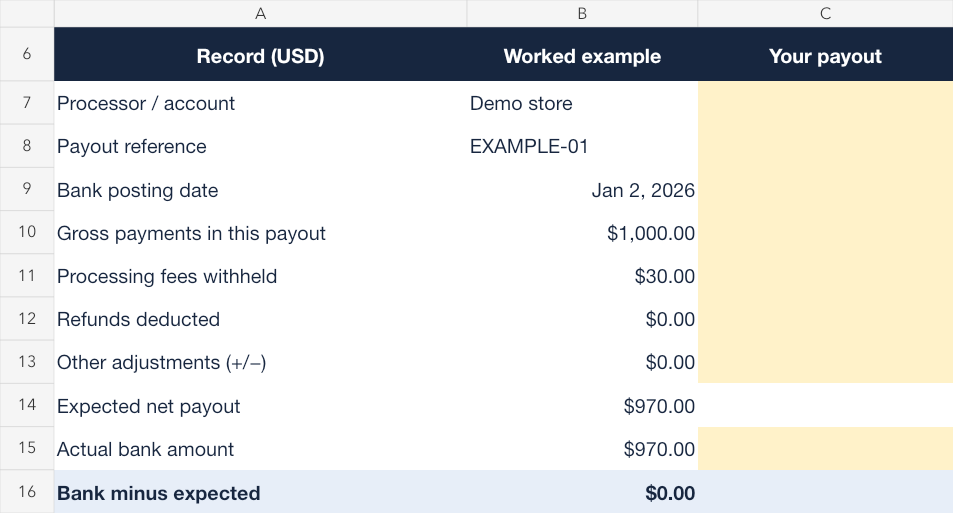
Find the payout ID on the processor’s settlement report. Use the payments, fees, refunds and reserve changes assigned to that batch. In this example the batch contains one customer payment and one fee.
| Payout record | Amount |
|---|---|
| Gross customer payment | $1,000.00 |
| Processing fee withheld | −$30.00 |
| Refunds deducted | $0.00 |
| Other payout adjustments | $0.00 |
| Expected net payout | $970.00 |
| Actual bank deposit | $970.00 |
| Bank minus expected | $0.00 |
If the processor also deducts a $100 refund in this batch, the expected payout becomes $870. Trace any difference to the payout detail. A refund from a different batch belongs with that batch. The $30 fee here is an example, not a quoted processing rate.
1099-K reconciliation worksheet
Use Payout check to reconcile one settlement and Annual check to compare one form with twelve months of processor gross activity.
A December sale can reach the bank in January
Suppose the example card payment took place on December 31, 2025, and the $970 landed in checking on January 2, 2026. The processor uses the transaction date for the gross amount on the 2025 form. Match the deposit to the January 2026 bank statement and keep the same payout ID with both records.
If the annual gross still differs after checking the dates and accounts, compare the monthly gross amounts with the issuer’s records. Contact the issuer shown on the form if it needs correcting, and keep the correspondence. See the IRS guidance for recipients.
Find both sides of the payout in Bokeping
- In Sales & Receivables → Payments Received, find the gross customer payment and the account it was deposited into. An integrated processor payment can be recorded in a clearing account.
- In Banking → Bank transactions, find the bank entry by net amount, date and payout reference. Check for an existing settlement and recorded fees or refunds before posting anything new.
- Use the provider’s payout breakdown to match the settlement. If the $1,000 receipt is already in the books, recording the $970 deposit as another sale would count the same money twice. Keep unresolved items with the records for your accountant.
IRS sources
Checked .
- IRS instructions for Form 1099-K · Box 1a, calendar-year transaction dates and monthly gross amounts.
- IRS guidance on what to do with Form 1099-K · Gross payments, adjustments, recordkeeping and asking the issuer for a correction.