 Bokeping
Understand FIFO, average cost, and inventory cost scope
Check how inventory cost reaches your accounts and why the valuation method may be locked.
In BokepingSettings → Products & Services
Your inventory selling price and inventory cost serve different purposes. Selling price helps calculate revenue; inventory cost determines the stock value carried forward and the cost recognized when stock is sold.
Where to go: Settings → Products & Services. The page heading is Items.
Check the method before entering stock
Section titled “Check the method before entering stock”- Review Inventory valuation method: Moving weighted average (AVG) or First in, first out (FIFO).
- Review Inventory cost scope: Company-wide (one cost pool per item) or Per warehouse.
- Review the income, cost of goods sold, operating expense, and inventory asset account defaults.
- If you are setting up new books, agree these choices with the person responsible for inventory accounting before recording stock activity.
- After an authorized change, save and reopen the page to confirm the settings. Review affected item defaults separately; changing a default is not a correction to an old transaction.
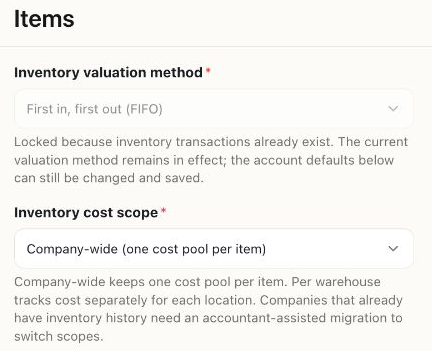
The Demo company’s method is locked because inventory transactions exist. This is a read-only example; no costing setting was changed.
Example: the same stock, different cost allocation
Section titled “Example: the same stock, different cost allocation”Assume you buy 10 identical units at $8 and another 10 at $12, then sell 5. There are no other movements or costs.
| Method | Cost of the 5 units sold | Value of the 15 units remaining |
|---|---|---|
| FIFO | 5 × $8 = $40 | 5 × $8 + 10 × $12 = $160 |
| Moving weighted average | 5 × $10 = $50 | 15 × $10 = $150 |
Both begin with $200 of stock and end with 15 units. AVG recalculates the moving average as stock comes in; it is not an average of selling prices. This example does not include returns, backdated changes, or stock shortages.
Method and scope are separate decisions
Section titled “Method and scope are separate decisions”Method determines which costs are assigned to outgoing units. Scope determines whether locations share an item’s cost pool. A company-wide pool can give a different result from separate warehouse pools when locations acquire the same item at different costs.
Enabling warehouse locations does not by itself establish that the cost scope changed. Check the saved scope and the warehouse setup.
Why a setting is locked
Section titled “Why a setting is locked”Once inventory transactions exist, the valuation method can be locked. Do not delete legitimate history or change opening balances to unlock it. Existing companies need an accountant-assisted migration to change cost scope; a normal settings save is not a substitute for that process.
The account defaults may still be editable while the method is locked. Cost of goods sold account is for inventory sold; Operating expense account is for service and non-inventory purchases. Review the specific item’s accounts before posting a purchase or sale.
Investigate a cost that looks wrong
Section titled “Investigate a cost that looks wrong”Run Inventory Valuation at the same date and scope. Compare the quantity, original purchase/opening cost, returns, adjustments, and transaction dates. A later or backdated source change may need a cost correction; do not overwrite a selling price to fix inventory value. Keep the source document and its related accounting adjustments together during review.